Send RM100 via DuitNow Transfer using a bank account number to your friend Nur Aisha.
Her name pops up before you confirm.
Obvious, right? You would want to see who you’re paying.
Now here’s the weird part: until October 2025, this didn’t happen in Europe.
You’d enter the IBAN, the name, hit send.
The bank would credit the IBAN. The name? Nobody checked.
I work on KYP (Know Your Payee) at a fintech, and the first thing I had to figure out was why this was a problem at all.
Turns out the name was always there. SEPA messages have carried a creditor name field for years. It just wasn’t validated end-to-end.
The receiving bank looked at the IBAN, credited the account, ignored the name.
The Instant Payment Problem
That worked when payments were slow. If you got the name wrong, there was time to recall.
Then payments got instant. Cleared in seconds, irrevocable.
Scammers figured out they could trick people into sending money to accounts that weren’t who the sender thought they were.
So the EU mandated Verification of Payee (VoP) across the Eurozone on 9 October 2025. Before any SEPA transfer, the sender’s bank has to ask the receiving bank: does this name match this account?
The DuitNow Difference
When I first read the spec, it felt like a uniquely European problem.
Then it clicked. DuitNow has been doing this in Malaysia the whole time.
When you DuitNow someone, PayNet sends an inquiry to the receiving bank. The bank returns the name. That’s the same shape as VoP — query the bank that holds the account.
What differs is what you ask.
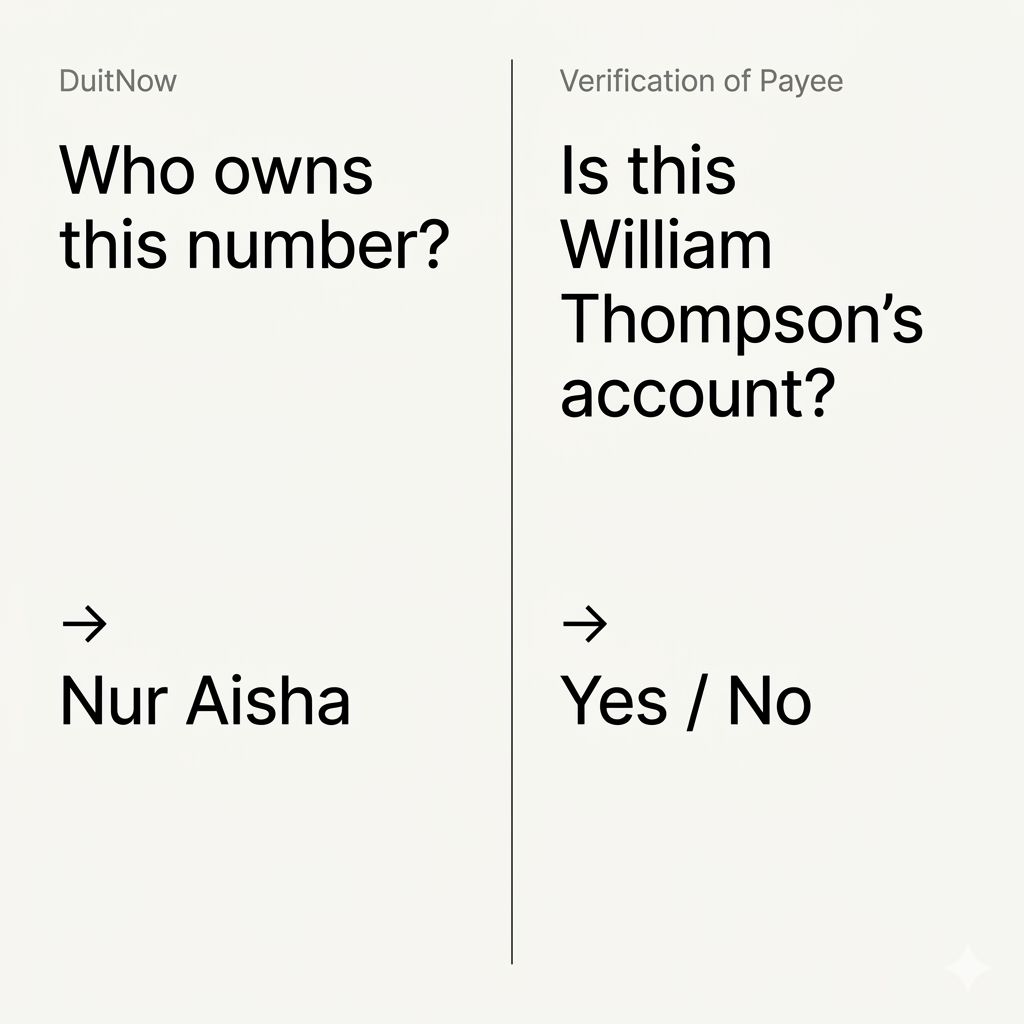
DuitNow asks “who owns this account number?” — answer comes back as “Nur Aisha”.
VoP asks “is this William Thompson’s account?” — answer is yes or no.
You verify, confirm, send.